
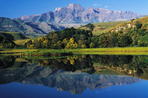
The Drakensberg Mountains, meaning 'Dragon Mountains' in Afrikaans, are the highest mountains in South Africa, ranging up to 3,482 m (11,422 ft) in height.
In isi-Zulu, the language of the Zulu People, they are called "uKhahlamba", the 'barrier of spears'. They are located in the eastern part of South Africa, running for some 1000 km (600 mi) generally southwest to northeast, with a northwesterly bend forming the northeastern border of Lesotho with South Africa.
They are drained on the west by the Orange and Vaal rivers, and on the east and south by a number of smaller rivers, the Tugela being the largest. The range thus separates KwaZulu-Natal Province from Free State Province, looming over the nearby coast of Natal.
But don't let the formidable names put you off. Cosy inns, characterful hotels and wonderful wayside pubs create an ambience of comfort and country homeliness in the shadow of the High Berg. The nearest major city to the Drakensberg is Pietermaritzburg and Durban is a drive of only a few hours away.
It's a popular hiking destination. There are lots of lovely day walks and the more energetic could hike out for a few days or even a few weeks. The Drakensberg Traverse is quite difficult, but for those who have the time, inclination, energy and equipment, this 300km (180 mile) hike is a challenge and a delight.
Snow falls regularly in the winter, while rains and mists can occur year-round. Many of the Drakensberg peaks offer challenging mountaineering. While the major summits have all been conquered, a number of minor pinnacles have yet to be ascended. Hiking is also a popular activity. Animals likely to be seen include the enormous Eland, Reedbuck, curious Baboons, and the highly endangered and endemic Lammergeier (bearded vulture). Tourism in the Drakensberg has been developing, with a variety of hotels and resorts appearing on the slopes.
Most of the South African side of high part of the range has been designated as game reserve or wilderness area. The uKhahlamba or Drakensberg National Park, located in KwaZulu-Natal, near the border with Lesotho, was inscribed by UNESCO in 2000 as a World Heritage site.
The park is also in the List of Wetlands of International Importance. The most well known park in the Drakensberg Mountains in KwaZulu-Natal, South Africa, is the Royal Natal National Park. It contains the source of the Tugela river, and includes the 912m high Tugela Falls, the second highest waterfall on earth.
Tens of thousands of Bushman San rock paintings can be seen around the Drakensburg area - the last visible signs of the ancient Bushman or San people. These tiny wanderers were nearly wiped out by the waves of Khoi, abaNtu and white settlers over the centuries. The Bushman San people are recognised as the indigenous inhabitants of the sub-continent. Yet there is no monument to the Bushman San people - other than their own art.
Within the uKhahlamba-Drakensberg Park there are some 600 sites, collectively representing over 35000 individual images. Remarkably, the rock art in the park is better preserved than any other region south of the Sahara. The oldest painting on a rock shelter wall in the park is about 2400 years old, while more recent creations date back to the late nineteenth century. Many of the sites contain scenes depicting hunting, dancing, fighting, food gathering and rituals.
 The Drakensberg mountain range, stretching along the eastern side of South Africa, is a place of rugged beauty made up of plateaus, peaks, c...
 The spectacular uKhahlamba Drakensberg Park in KwaZulu-Natal, South Africa, now known as Maloti Drakensberg Park is located just two hours f...