
Pilanesberg, North West Province

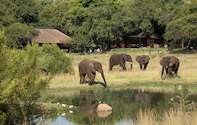
Pilanesberg National Park, North West Province, South Africa is set on 55 000 hectares 50km / 93 miles from the Gauteng metropolis and 60km / 37 miles north of Rustenburg.
The malaria-free Pilanesberg National Park near Sun City Resort in the North West Province, South Africa is the country’s 4th largest park and can be reached from Johannesburg or Pretoria in 2 hours by car. An abundance of wildlife resides in this diverse and arresting bushveld terrain.
The crater of a long extinct volcano is the setting of Pilanesberg National Park, North West Province, South Africa. This fascinating alkaline complex produced by volcanic eruptions some 1300 million years ago, is one of the largest of its kind in the world. Its rare rock types and structure make it a special geological feature.
Pilanesberg’s rugged landscape, well-watered valleys and attractive dwelling sites have made it an ideal site for human settlement for thousands of years. Numerous Stone and Iron Age sites are scattered throughout the park. Since 1979 the park has undergone major reclamation and development turning what was farming land into a premier game reserve.
Pilanesberg National Park Wildlife

Pilanesberg is home to the Big Five animals, Elephant, Buffalo, Black and White Rhino, Leopard and Lion. Brown Hyena endangered Cheetah, Sable, Giraffe, Zebra, Hippo and Crocodile can all be seen as well as prolific birdlife. This game park in the North West Province of South Africa is located within the transition zone of the dry Kalahari and wetter Lowveld vegetation, known as 'Bushveld'.
Unique overlaps of mammals, birds and vegetation occur because of this transition zone. Springbok, Brown Hyena, the Redeyed Bulbul and Camel Thorn trees usually found in arid areas are found co-habiting with moist-area-limited Impala, Blackeyed Bulbul and Cape Chestnut trees.
